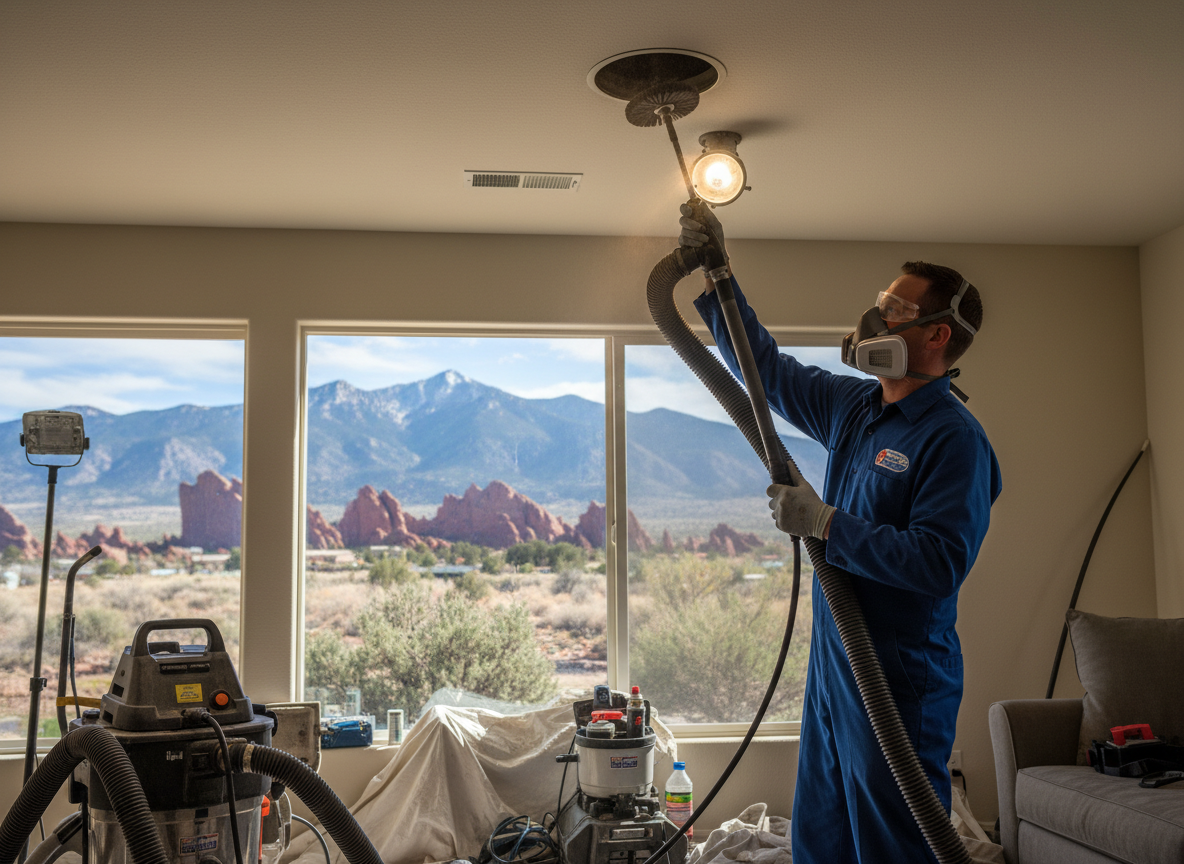
Colorado Springs sits in El Paso County under a semi-arid high-plains climate that sends fine dust and pine pollen through every vent during hot summers and again when cold winter winds blow down from Pikes Peak. Homes in Old Colorado City and Manitou Springs often have original duct runs from the 1940s and 1950s that trap this material against metal seams and fiberglass liners. A 24/7 crew must be ready to isolate those runs, use negative-air machines, and clean without disturbing settled insulation in crawl spaces that sit close to the rocky soil.
Broadmoor and Briargate neighborhoods contain a mix of mid-century ranchers and newer two-story builds where supply trunks run through attics that swing from 90-plus degrees in summer to below freezing in winter. Rapid temperature changes cause condensation on metal when warm indoor air meets cold ducts, leading to hidden mold spots that only appear after the system is opened. Technicians working overnight learn to check every elbow and register boot because a single missed section in Rockrimmon can recirculate allergens the next day.
Security-Widefield and Fountain homes sit on flatter ground with longer, straighter duct runs that collect heavier construction dust from nearby building sites. These longer lines require more access points and stronger vacuum equipment to reach the main trunk without collapsing flexible sections. Crews also watch for rodent droppings common in the open fields between Colorado Springs and Pueblo that get pulled into return ducts during high-wind events.
The United States Air Force Academy and Olympic Training Center areas bring newer construction but tighter building envelopes that push more air through the same square footage of duct. This higher velocity moves fine particles deeper into the system, so a standard brush alone often fails. Only a combination of agitation tools and HEPA-filtered extraction clears the deeper sections without blowing debris back into living spaces.
Technician insight
In Colorado Springs the thing that catches most people out with 24/7 Air Duct Cleaning is how fast the dry high-plains air loads older ducts in Old Colorado City and Manitou Springs with fine dust that only moves when winter winds hit. Homeowners think one quick vacuum will fix it, but those 70-year-old seams hold material that needs both agitation and strong negative pressure or it just settles again the next day.
Overnight Call in Briargate
A homeowner in Briargate noticed heavy dust on surfaces every morning despite recent filter changes. We opened the attic ducts and found thick layers of pollen and construction dust that had settled during the summer heat. Using rotary brushes and a full negative-air setup we cleared the lines in four hours. The next morning the family reported no new dust and steady airflow from every register.
How it works
- 1
Initial Assessment
Arrive at the property, inspect all accessible ducts, and identify access points while noting any insulation or rodent issues common in El Paso County homes.
- 2
System Isolation
Seal off the HVAC unit and create negative pressure with HEPA equipment to prevent dust from entering living areas during cleaning.
- 3
Agitation and Extraction
Use rotary brushes and compressed air tools to dislodge debris from ducts, pulling everything into the vacuum system in one continuous pass.
- 4
Register and Boot Cleaning
Remove and clean every vent cover and boot, then vacuum inside the boots to clear remaining material before reinstalling.
- 5
Final Verification
Run the system, check airflow at each register, and confirm no debris remains before leaving the home.
Pricing
Cost depends on square footage, number of access points needed, and whether insulation or pest debris is present; call for an on-site assessment.