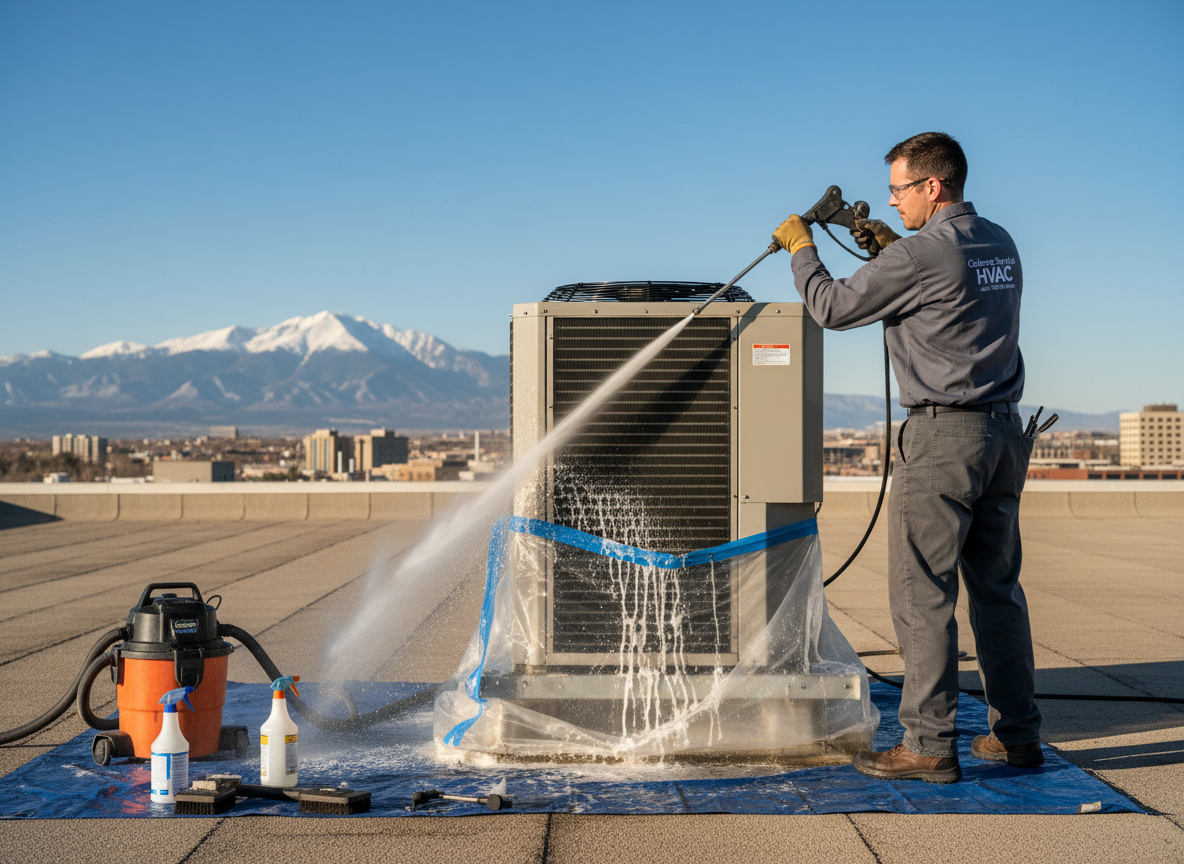
In El Paso County homes built in the 1960s and 1970s around Old Colorado City and Broadmoor, evaporator coils collect fine high-plains dust that blows in from open spaces near Cheyenne Mountain. This dust mixes with winter furnace run times and summer cooling cycles, forming a layer that restricts airflow and raises energy use. Technicians use non-acidic coil cleaners rated for aluminum fins to avoid pitting while brushing between tight spacing common on older Lennox and Carrier units found in these neighborhoods.
Condenser coils on units placed in backyards of Manitou Springs and Rockrimmon properties face extra challenges from pine pollen and occasional alkali dust carried on winds from the eastern plains. When coils stay coated, head pressure climbs and compressors work harder during 90-degree July afternoons. Proper cleaning includes straightening bent fins with a fin comb and rinsing with low-pressure water to prevent water intrusion into electrical compartments during sudden afternoon storms.
Technicians also inspect drain pans and lines for algae growth triggered by the dry climate alternating with brief humidity spikes. Neglected pans in Briargate homes can lead to overflow onto attic insulation. Cleaning includes treating the pan with an EPA-registered biocide safe for the local water table and verifying proper slope so condensate exits freely before cold nights return.
Edge cases include coils in units near the United States Air Force Academy where road salt from winter plowing on I-25 accelerates corrosion on lower fins. In these situations, a protective coating rated for high-UV exposure is applied after cleaning to extend service life without voiding manufacturer warranties.
Technician insight
In Colorado Springs the thing that catches most people out with Coil Cleaning HVAC is how fast the dry high-plains dust packs into the lower rows of condensers on homes in Broadmoor and Manitou Springs once winter furnace use starts. Homeowners often run the system for months before noticing the efficiency drop because the thin mountain air masks the restriction until summer heat arrives.
Broadmoor Condenser Coil Restoration
A 1980s split system in a Broadmoor home showed rising energy bills after repeated high-wind dust events. Inspection revealed packed alkali dust on the lower condenser fins plus bent sections from hail. The coils were cleaned with non-acidic solution, fins straightened, and a protective coating applied. The homeowner reported quieter operation and lower cooling costs the following month.
How it works
- 1
Initial System Inspection
Technician examines both evaporator and condenser coils for visible dust load, fin damage, and drain line condition while noting unit age and placement relative to Pikes Peak wind patterns.
- 2
Coil Preparation
Power is isolated at the disconnect, and protective sheeting is placed over nearby surfaces before applying coil cleaner formulated for semi-arid dust conditions.
- 3
Cleaning and Rinsing
Coils are brushed and rinsed at controlled pressure, with special attention to lower rows where alkali residue collects in Colorado Springs installations.
- 4
Fin Straightening and Treatment
Bent fins are combed straight and a UV-protective coating is applied when corrosion risk is elevated near roadways in Security-Widefield or Fountain.
- 5
System Restart and Verification
Power is restored, airflow and temperature differential are checked, and the homeowner receives a written summary of coil condition and any noted restrictions.
Pricing
Pricing varies by unit size, access difficulty, and coil condition; most residential jobs in El Paso County fall in the mid-range for professional HVAC coil work.