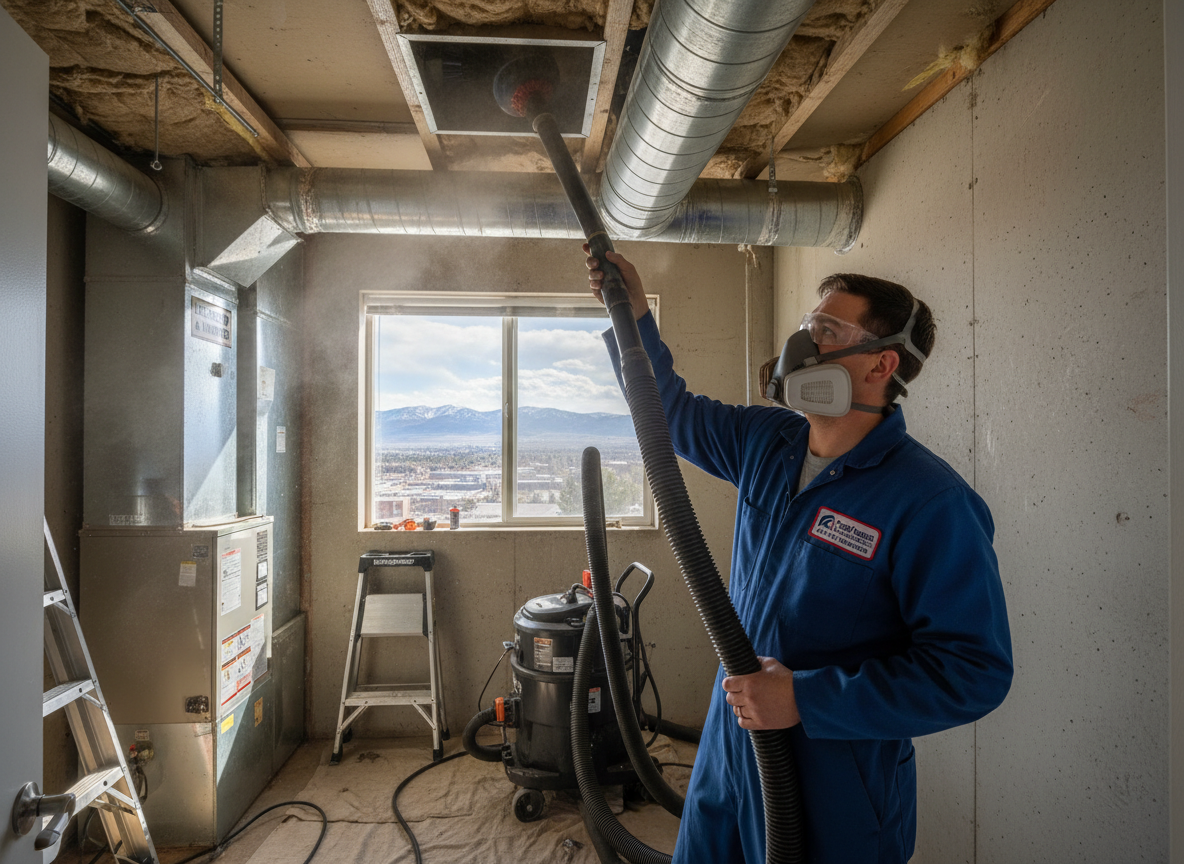
Colorado Springs homes built before 1980 in Old Colorado City and Manitou Springs often have rigid metal duct runs that collect fine high-plains dust and cottonwood pollen. Cold winter nights pull that debris deeper into the system while hot summer afternoons push it back into living spaces. Summit Timber techs at 30 E Pikes Peak Ave use negative-air machines sized for these older, leakier trunks so the entire run is cleaned without disturbing plaster walls or disturbing the steep grades around Cheyenne Mountain.
El Paso County properties near the United States Air Force Academy and Rockrimmon sit on shallow bedrock that transmits vibration from nearby traffic. Over decades this loosens duct joints, allowing attic insulation fibers to enter the airstream. Our crews isolate each trunk section before agitation, then seal the joints with mastic rated for the area’s extreme temperature swings between summer heat and winter lows. This prevents the same fibers from re-entering after the job.
Security-Widefield and Fountain tract homes built in the 1990s frequently share return-air chases with laundry rooms that pull dryer lint. The semi-arid climate dries the lint so it becomes airborne easily. We always start at the farthest register and work toward the furnace, using whips sized for the narrow rectangular ducts common in these neighborhoods, then verify airflow at the plenum before leaving the site.
Pueblo commuters who live in Briargate often run furnaces continuously from October through April. That extended runtime packs dust against the evaporator coil and into the supply boots. Summit Timber finishes every job by removing the coil access panel, brushing the fins, and confirming static pressure returns to the manufacturer’s specification for the home’s elevation.
Technician insight
In Colorado Springs the thing that catches most people out with Licensed And Insured Duct Cleaners is how fast the dry high-plains dust packs into the narrow rectangular returns of 1990s Briargate homes once winter heating starts; if you only clean the main trunk the fine silt migrates right back from those returns within a week.
Broadmoor Return Chase
A 1970s Broadmoor house showed poor airflow on the second floor after every heating season. We found the shared return chase behind a knee wall packed with decades of cottonwood fluff and insulation fibers. After isolating the chase and running whips the full length, airflow at the upstairs registers returned to normal and the homeowner reported the furnace no longer short-cycled on cold nights.
How it works
- 1
Site Assessment
We map every register and return in the home, noting duct material and any visible gaps common in El Paso County crawl spaces.
- 2
Containment Setup
Negative-air machines are placed at the furnace and each main trunk to keep dust from migrating into living areas during agitation.
- 3
Agitation and Extraction
Rotating brushes and compressed-air whips loosen debris while the vacuum pulls it outside; work proceeds register by register from farthest point inward.
- 4
Coil and Plenum Service
Accessible coils are brushed and plenums are vacuumed; joints are sealed where temperature swings have loosened them.
- 5
Final Airflow Check
Static pressure and register airflow are measured to confirm the system moves air at pre-clean levels before equipment is removed.
Pricing
Pricing varies by number of trunks, access difficulty in crawl spaces or attics, and whether coil cleaning is needed; upfront quotes are provided on site.